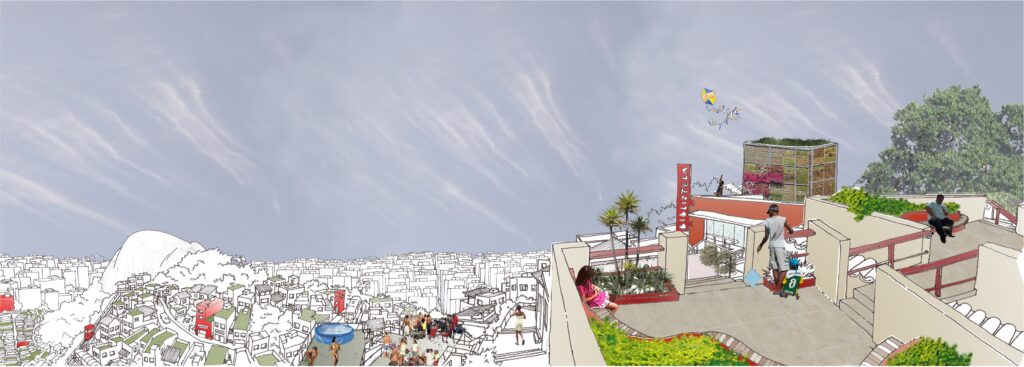
Urban Interventions in Favelas: The Architect in the Collective Process of Building and Transforming Cities
Period: 2010-2012 (Master Thesis)
Funding: CAPES
This research project, developed as part of a Master’s thesis at the Federal University of Rio de Janeiro under the supervision of Prof. Dr. Luciana Andrade, critically reflects on the role of the architect in the transformation of cities, with a particular focus on territories where architectural practice has historically been absent or limited—namely, informal settlements and favelas. Centered on Favela da Providência, the oldest favela in Rio de Janeiro, the work understands architecture, space, and society as deeply interconnected and inseparable dimensions of urban intervention.
The study questions the traditionally assumed protagonism of the architect within both professional practice and architectural education, where design authority is often concentrated in technical expertise, frequently overshadowing the knowledge and agency of other actors. Drawing on the work of theorists such as Carlos Nelson Ferreira dos Santos and Jane Jacobs, the research explores the consequences of this imbalance, particularly the disconnection between architectural interventions and the pre-existing social practices embedded in everyday life.
By examining processes of favela urbanization, the research highlights the challenges of communication and collaboration between technical professionals, government institutions, and local communities. These challenges often result in interventions that inadequately respond to the needs, desires, and lived realities of residents. Through an in-depth analysis of projects and, crucially, the decision-making processes involved in the urbanization of Favela da Providência, the study reveals significant divergences in discourse among stakeholders and a recurring lack of comprehensive engagement with the community’s social dynamics and spatial practices.
Rather than proposing definitive solutions, the work seeks to raise critical questions and contribute to an ongoing reflection on the role of the architect in society. It advocates for more inclusive, dialogical, and context-sensitive approaches to urban transformation, in which architects act not as sole protagonists but as facilitators of collective processes. In doing so, the research points toward the possibility of more equitable, responsive, and socially grounded forms of city-making.
Outcomes
Master Thesis